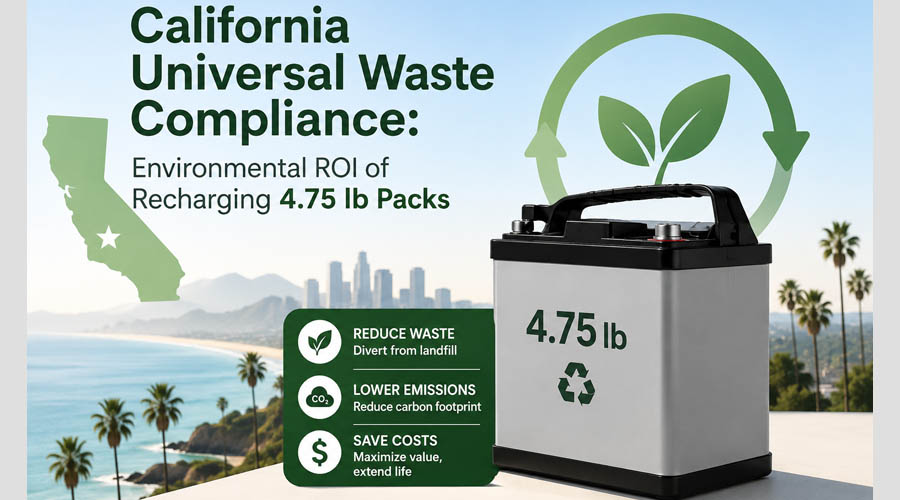
For environmental health and safety (EHS) managers and operations directors in San Diego, managing depleted heavy-duty electronics isn’t just a matter of logistics—it’s a major legal checkpoint. Industrial-grade 4.75 lb alkaline battery packs used in oceanographic telemetry, railway signals, and remote environmental monitoring contain substantial bulk material.
Under California’s strict regulatory framework, how your enterprise handles these spent units directly impacts both your compliance record and your operational bottom line.
Deploying a professional restoration strategy instead of a standard disposal model yields a significant Environmental Return on Investment (Environmental ROI). Here is how recharging these 4.75 lb packs keeps your company compliant with evolving California laws while advancing your sustainability goals.
1. The Legal Framework: California Universal Waste Regulations
In California, the Department of Toxic Substances Control (DTSC) explicitly classifies all alkaline and battery-embedded products as Universal Waste. Under the state’s stringent rules, throwing these items into standard commercial or municipal trash streams is entirely prohibited.
The financial and legal stakes for non-compliance are exceptionally high:
-
›
Escalating Civil Penalties: Administrative and civil penalties enforced by the DTSC for improper hazardous waste management can reach up to $70,000 per violation, per day. -
›
Increased Enforcement: State and local auditing of commercial refuse bins has intensified, leaving zero margin for error in corporate waste documentation. -
›
SB 1215 Impact: Evolving regulations actively hold entities accountable for the complete lifecycle of heavy battery assemblies and battery-embedded products.
By transitioning from a “buy-and-toss” model to a professional recharging program, your company significantly reduces the volume of hazardous material moving through its waste pipeline.
2. Calculating the Environmental ROI of Alkaline Restoration
Traditional recycling—where batteries are collected, crushed, chemically treated, and smelted—is energy-intensive and incurs ongoing logistical fees. Professional restoration operates higher up on the waste hierarchy by practicing source reduction.
The environmental dividends of choosing a closed-loop restoration program include:
Decreasing Your Hazardous Waste Generation Footprint
Every 4.75 lb alkaline pack that undergoes professional restoration is a unit that does not enter the hazardous waste stream. For mid-to-large-scale operations cycling hundreds of units annually, this equates to thousands of pounds of technical waste eliminated from your company’s monthly DTSC generation tracking.
Drastic Carbon Footprint Reducings
The extraction of raw zinc and manganese dioxide along with heavy industrial shipping of new OEM packs produces massive Scope 3 supply chain emissions. Extending the lifespan of an existing 4.75 lb pack through safe charging profiles keeps those active materials in play, directly cutting your operational carbon metrics.
3. Merging Compliance with Resource Preservation
When evaluating procurement and end-of-life options, the safest choice is the one that minimizes data reporting and environmental risk.
| Metric | Traditional “Buy-and-Toss” Model | Certified Closed-Loop Recharging |
|---|---|---|
| DTSC Regulatory Risk | High — Requires strict oversight and chain-of-custody tracking | Low — Maintains existing assets; delays waste classification |
| Scope 3 Supply Chain Emissions | High — Heavy manufacturing and international transport | Minimal — Localized processing and zero raw material extraction |
| Disposal Logistics & Auditing | Ongoing paperwork and hazmat shipping costs | Streamlined — Simple inventory cycling |
To understand how these eco-friendly compliance practices convert into direct operational savings, read our detailed financial breakdown: New vs. Recharged: Calculating Your Savings on 4.75 lb Alkaline Batteries.
4. Securing Workplace Safety Under EHS Guidelines
Aside from the clear outdoor environmental benefits, keeping spent cells on-site without a plan creates internal hazards. Dead alkaline packs left in storage facilities can leak potassium hydroxide (a corrosive agent), damaging corporate infrastructure and risking workplace chemical burns.
A structured restoration cycle mitigates this risk entirely. Units are promptly audited, tested, and restored under strict thermal and electrical control standards. For a deep dive into the precise laboratory methods that ensure this process remains safe, view our technical guide: Safety First: Professional Protocols for Recharging Industrial 4.75 lb Alkaline Packs.
Frequently Asked Questions
Is it legally compliant to recharge industrial alkaline batteries in California?
Yes. Professional restoration is classified as a source reduction and asset management strategy. By safely extending the lifespan of your active infrastructure, you legally delay the point at which the battery must be classified, logged, and tracked as Universal Waste.
How do strict environmental laws affect my company’s battery procurement?
Businesses must choose between continuously budgeting for specialized disposal compliance or building a circular loop. Opting for restoration cuts procurement costs, minimizes waste documentation, and lowers point-of-sale recycling fees.
What happens to a 4.75 lb alkaline pack when it can no longer be recharged?
Once an industrial pack fails to meet performance metrics during the diagnostic phase, it is officially classified as Universal Waste and processed through specialized, certified e-waste facilities to recover high-grade metals for future manufacturing.
How is your enterprise navigating the latest updates to California’s Universal Waste regulations? Have you incorporated battery lifecycle extension into your corporate ESG goals?