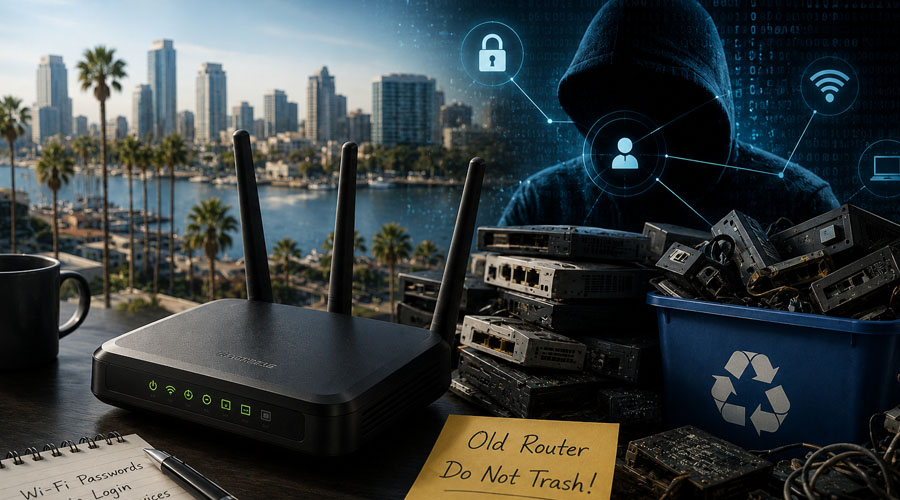
When a business upgrades its network — new firewalls, faster switches, a fresh Wi-Fi rollout — the old hardware usually ends up in a closet, a storage room, or worse, the trash. IT teams in San Diego often treat routers and switches as an afterthought compared to servers or laptops. But networking equipment carries its own set of legal, security, and environmental risks that shouldn’t be ignored.
At Next Life Recycling, networking equipment is one of the categories we handle as part of our Corporate E-Waste Recycling service in San Diego. Here’s what actually happens to old routers, switches, and firewalls once a business is done with them — and why the disposal process matters more than most IT teams realize.
Why Old Networking Gear Isn’t Just Junk
In California, networking equipment falls under the same e-waste regulations as computers and monitors. Circuit boards inside routers, switches, and firewalls contain heavy metals and flame retardants that classify them as Universal Waste under DTSC rules — meaning they cannot legally go into a regular trash or recycling bin.
Beyond the legal side, networking hardware tends to sit unused far longer than other IT equipment. A switch that’s been pulled from service but never processed can sit in a closet for years, taking up space and quietly becoming an audit liability if a business is ever asked to account for its retired assets.
The Data Security Risk Most IT Teams Overlook
Routers, switches, and especially firewalls aren’t just plastic and circuit boards — they hold configuration data. Firewalls in particular can retain VPN credentials, firewall rules, IP address schemes, and sometimes cached authentication data long after they’ve been pulled from a network.
A factory reset is a good first step, but it isn’t always a guarantee. Some enterprise-grade devices store configuration backups in flash memory that a basic reset doesn’t touch. Before any networking equipment leaves your building, it should go through the same kind of scrutiny you’d apply to a retired server or hard drive.
What Counts as Networking Equipment
We accept a wide range of network infrastructure as part of our corporate pickup service:
-
›
Routers and Firewalls: From single-office units to enterprise-grade appliances used in data centers. -
›
Switches: Managed and unmanaged switches, rack-mounted or standalone. -
›
Wireless Access Points: Retired Wi-Fi hardware from office or campus-wide rollouts. -
›
Modems and Gateways: Both business-grade and legacy units. -
›
Cabling and Patch Panels: Structured cabling removed during office moves or network overhauls.
Our Networking Equipment Recycling Process
Inventory & Pickup: Tell us roughly what you have — routers, switches, APs — and we schedule a pickup directly at your San Diego location.
Configuration Wipe: Devices are reset to factory defaults, clearing stored credentials, VPN configs, and network settings.
Sorting & Dismantling: Equipment is sorted by type at our facility, with components separated for proper material recovery.
Certified Processing: Materials are processed in accordance with California e-waste law, with documentation available for your records.
Networking equipment is just one part of a larger IT refresh. If you’re also retiring servers, desktops, or storage media at the same time, our Corporate E-Waste Recycling service can handle the entire pickup in one visit.
Frequently Asked Questions
Can I just throw an old router in the trash?
No. In California, networking equipment is classified as Universal Waste and can’t legally go into regular trash or municipal recycling bins. It needs to go through a certified e-waste recycler.
Do you accept damaged or non-working networking equipment?
Yes. Whether a device is fully functional, partially damaged, or completely dead, we accept it as part of our recycling process.
How do you handle firewalls with stored VPN credentials?
Every device goes through a configuration reset before processing. For businesses with strict compliance requirements, we can coordinate additional data destruction steps alongside our standard corporate service.
Do you pick up cabling and patch panels too?
Yes. Structured cabling and patch panels removed during office moves or network overhauls can be included in the same pickup as your other retired equipment.
Is your business planning a network refresh in San Diego? Contact Next Life Recycling to schedule a pickup for your retired routers, switches, and networking hardware.