For operations managers and procurement officers, managing heavy infrastructure comes down to balancing predictability with cost control. If your facility runs an inventory of heavy-duty 4.75 lb industrial alkaline battery packs, you already know how quickly replacement costs can compound.
However, moving away from the traditional, wasteful procurement pipeline doesn’t happen overnight. Transitioning your enterprise from a “buy-and-toss” model to a highly efficient circular inventory requires a structured roadmap.
This step-by-step guide outlines exactly how to integrate professionally restored 4.75 lb alkaline packs into your daily workflows while ensuring safety, compliance, and immediate cost reductions.
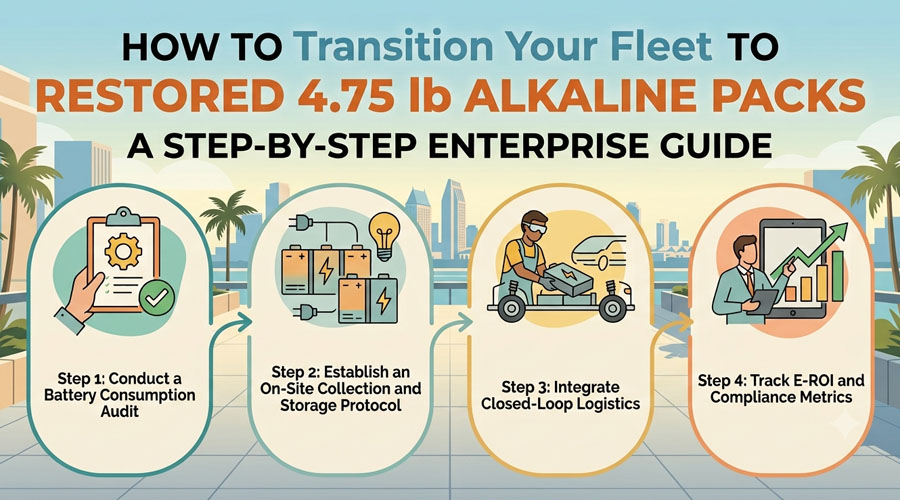
Step 1: Conduct a Battery Consumption Audit
Before changing your logistics, you need an accurate baseline of your enterprise’s energy footprint. Many companies treat industrial batteries as minor line-item expenses until the yearly total is calculated.
-
›
Log Your Volume: Review procurement invoices from the past 12 months to determine exactly how many 4.75 lb blocks your facility cycles through per quarter. -
›
Identify Discharge Profiles: Note whether your equipment drains these battery packs completely (deep discharge) or leaves substantial residual voltage. Packs pulled before total exhaustion often yield the highest restoration success rates. -
›
Calculate Baseline Costs: Sum up the purchase price, shipping premiums for heavy freight, and any specialized hazardous waste processing fees your company currently pays.
Step 2: Establish an On-Site Collection and Storage Protocol
Industrial alkaline cells are rugged, but they are not indestructible. To maximize the number of packs that can be successfully restored, your team must store spent units correctly. Leaving dead cells scattered around a facility degrades their internal chemistry.
-
›
Prevent Leakage: Store spent packs in a cool, dry environment. Allowing dead batteries to sit in high-temperature environments accelerates the degradation of internal seals, leading to potassium hydroxide leakage. -
⚠
Isolate Terminals: Ensure that terminal contacts on spent blocks do not touch one another during storage. Even a depleted 4.75 lb pack can retain enough residual energy to spark if short-circuited. -
›
Follow EHS Standards: Ensure your storage area aligns with internal Environmental Health and Safety (EHS) mandates. For a comprehensive look at the industrial-grade handling needed to keep these units stable, see our guide on Safety First: Professional Protocols for Recharging Industrial 4.75 lb Alkaline Packs.
Step 3: Integrate Closed-Loop Logistics
The core of a successful transition is replacing your disposal pipeline with a cyclical exchange program. Instead of arranging for third-party hazardous waste hauling every time a batch of batteries dies, you establish an inventory rotation.
-
1
Batch Collection: Accumulate a designated quantity of spent 4.75 lb units to optimize freight handling. -
2
Diagnostic Triage: Your inventory is routed through professional diagnostic testing where each pack is evaluated under real-world loads to check voltage stability and structural integrity. -
3
Restoration & Return: Restored units that pass strict capacity validation are delivered back to your operational stock, ready to be redeployed into the field.
To easily set up this rotation and start restoring your spent units, you can utilize our specialized local service: Recharge Your 4.75 lb Alkaline Batteries in San Diego.
Step 4: Track E-ROI and Compliance Metrics
Once your circular loop is operational, the final step is documenting its impact for corporate leadership and environmental auditors.
-
›
Financial ROI: Compare the cost of your restored inventory against the market price of brand-new OEM replacements. Most mid-sized enterprises see immediate budget relief. To review an exact mathematical breakdown of these procurement dynamics, check out New vs. Recharged: Calculating Your Savings on 4.75 lb Alkaline Batteries. -
›
Environmental Reporting: Document the weight of the material kept out of the waste stream. By extending the life of these 4.75 lb blocks, your business actively reduces its Universal Waste generation metrics. This data is critical for satisfying strict state mandates, which you can read about in our compliance review: California Universal Waste Compliance: Environmental ROI of Recharging 4.75 lb Packs.
Frequently Asked Questions
How long does the transition to a restored battery fleet take?
An enterprise can typically transition its inventory within a single procurement cycle. Once an audit is completed and a safe on-site collection protocol is established, the rotation of spent blocks for restored blocks can begin immediately.
Do field technicians need special training to handle restored packs?
No. Professionally restored 4.75 lb industrial packs match original OEM form factors and electrical specifications exactly. Your team installs, monitors, and replaces them using the exact same operational procedures as new units.
What percentage of our existing battery inventory can be restored?
The success rate depends heavily on how the packs were stored and their depth of discharge. Units that are collected promptly after depletion and kept free of internal structural damage see remarkably high restoration yields during the diagnostic triage phase.
Is your facility ready to optimize its heavy-duty battery procurement? Contact our team today through our Recharge Your 4.75 lb Alkaline Batteries in San Diego service page to schedule your initial consumption audit and take control of your operational waste loop.