Router, switch, firewall — a lot of people use these words interchangeably, especially in a small office where one box sometimes does the job of all three. But when it’s time to retire your network equipment, knowing exactly what you’re recycling matters. Each device stores different kinds of data, carries different security risks, and needs to be handled a little differently before it leaves your building.
Here’s a plain-language breakdown of what each device actually does — and what that means when it’s time for networking equipment recycling in San Diego.
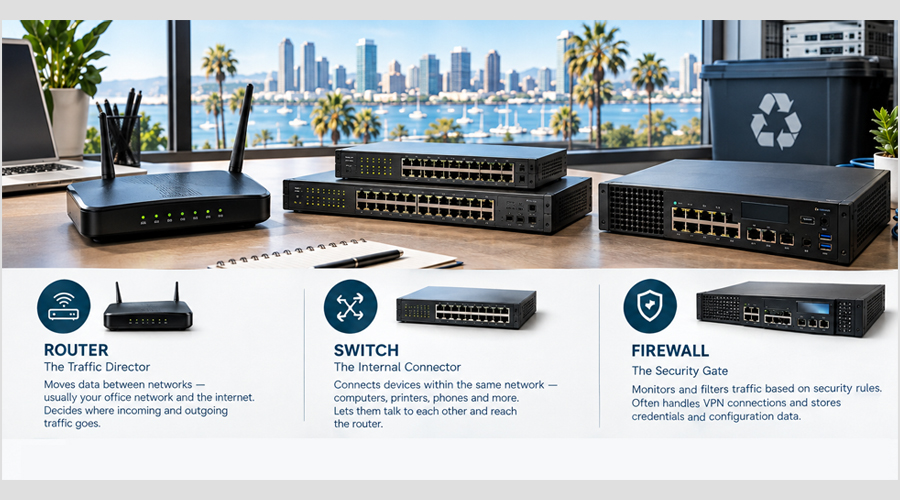
Router: The Traffic Director
A router’s job is to move data between networks — most commonly, between your office network and the internet. It’s the device that decides where incoming and outgoing traffic goes. Home and small-office routers are usually a single box; enterprise routers can be large, rack-mounted units handling traffic for an entire building.
Switch: The Internal Connector
A switch connects devices within the same network — think of every computer, printer, and phone on your office floor plugged into a central hub that lets them talk to each other and reach the router. Switches range from small 8-port desktop units to large rack-mounted switches handling hundreds of connections in a data center.
Firewall: The Security Gate
A firewall monitors and filters traffic based on security rules, deciding what’s allowed in and out of your network. Many modern firewalls also handle VPN connections, meaning they can store credentials and configuration data tied directly to how your business accesses its systems remotely.
What This Means for Recycling
All three devices are accepted through the same corporate recycling process, but they don’t carry the same level of risk once retired:
| Device | What It Stores | Data Risk Level |
|---|---|---|
| Router | Wi-Fi passwords, admin login, basic network settings | Moderate |
| Switch | Port configurations, VLAN settings (managed switches only) | Low |
| Firewall | VPN credentials, security rules, IP schemes, cached authentication data | High |
In practice, this means firewalls deserve the closest attention before pickup. A factory reset is a good first step for any of these devices, but for firewalls in particular, it’s worth confirming that stored VPN configurations and credentials are fully cleared — not just hidden from the admin panel.
One Recycling Process, Regardless of Device Type
Whatever mix of routers, switches, and firewalls your business is retiring, the process stays the same:
-
›
Configuration Wipe: Every device is reset to factory defaults before processing, regardless of type. -
›
Certified Handling: Routers, switches, and firewalls are all classified as Universal Waste under California law and processed accordingly. -
›
One Pickup, Any Mix: You don’t need to sort devices by type before we arrive — routers, switches, firewalls, and cabling can all go in the same pickup.
Retiring a full network setup — routers, switches, and firewalls together? Our Networking Equipment Recycling service handles all of it in one visit, and can be combined with Corporate E-Waste Recycling if you’re also retiring servers or desktops.
Frequently Asked Questions
Is a modem the same as a router?
Not quite. A modem connects your network to your internet service provider, while a router directs traffic within your network and to the internet. Many home and small-office devices combine both functions in a single box, which is why the terms often get mixed up.
Do unmanaged switches carry any data risk?
Very little. Unmanaged switches don’t have configuration settings to store, so there’s minimal data risk. Managed switches are different — they can hold VLAN and port configuration data worth clearing before recycling.
Can I recycle a router, switch, and firewall together?
Yes. There’s no need to separate device types before pickup — everything can go together in the same visit.
Not sure what’s still plugged in versus what’s been sitting retired in a closet? If your San Diego business has a mix of old networking gear, we can walk through what’s ready for pickup.